A Movement in Motion: Reflections on International Safe Abortion Day 2026
- Story
The global movement for abortion rights is reshaping the future–standing up in courts, inspiring public action, and amplifying personal stories that create lasting change.
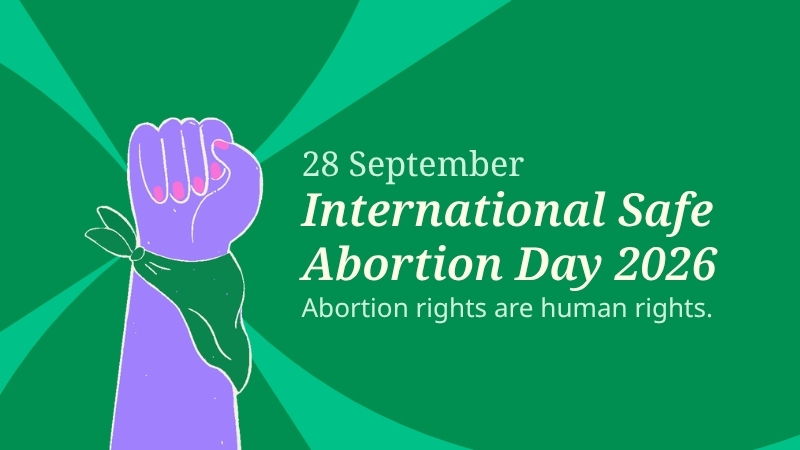
International Safe Abortion Day is the global day of action to demand safe, legal abortion care for everyone, everywhere.
Abortion is one of the world’s most common healthcare services. Human rights groups and courts around the world agree that abortion care is essential healthcare–and as a key part of people’s human rights, it should be safe, legal, and easily accessible.
Nearly 30% of all pregnancies end in abortion, and abortions happen everywhere: in places where they are legally available, restricted, and completely banned. The reality is that abortion rates remain similar across countries, regardless of the law.
It’s not a question of whether people will need abortion care. It’s a question of whether they will be able to access it safely when they do.
Moving forwardFaced with anti-rights opposition, the pro-abortion movement is fighting ahead.
Around the world, anti-abortion extremists continue to push policies that make abortion hard or impossible to access. Around 45% of worldwide abortions are unsafe–with unsafe abortion remaining one of the major global causes of preventable maternal death.
Despite these opposition efforts, 1.7 billion people today have stronger legal protections for abortion because of the Center’s work. The Center has fought and won key abortion cases in courts across the world, including the U.S. Supreme Court, United Nations forums, and regional human rights bodies.
To mark this year’s International Safe Abortion Day, the Center is reflecting on the forward momentum of our movement, even as anti-rights actors try to push us back. The advancements in the global movement for abortion rights over the last year cannot be captured by a single win. Instead, we see a movement advancing across multiple fronts: in the courts, through personal and public action, across borders.
This movement is a global effort that does not advance in one place or in one way. A person brings a case. A team of experts builds a legal strategy. A campaign brings people together. A win in one country becomes a blueprint for advocates on the other side of the world.
This is what it means to be a movement in motion.
Legal victories1. Legal victories set progressive precedents.
In the last year, courts and legislatures took real steps toward advancing abortion rights and protecting people’s ability to make decisions about their own bodies.
In the United Kingdom, Parliament officially ended the criminalization of women who terminate their pregnancies in England and Wales. In Kansas, a court permanently struck down abortion restrictions designed to make it harder to provide and access care. And a Kenyan High Court removed a restrictive clause in its reproductive health policy, reaffirming that the life and health of mothers must be protected and prioritized.
Reform continues across Europe: Switzerland made abortion care free of charge starting in 2027, Luxembourg became the second country in Europe to enshrine the freedom to access abortion in its constitution, and the Faroe Islands and Jersey both legalized abortion on request.
In Latin America, La marea verde, or the Green Wave, shows how the abortion rights movement can travel beyond borders. Beginning as a grassroots movement in Argentina, the Green Wave spread across the region, contributing to major abortion rights victories in Mexico, Ecuador, and Colombia, and becoming a model for advocates around the world.
The Green Wave’s momentum also inspired and strengthened other Latin American movements, such as Niñas no madres, which led to four historic, groundbreaking UN decisions. These far-reaching rulings set new human rights standards to ensure access to sexual education, safe abortion, and other protections for sexual abuse survivors—all of which will help prevent girls from being forced into pregnancy and motherhood.
And across Africa, a series of transformative legal and policy wins on reproductive rights have rippled from one country to the next, advancing the recognition of reproductive healthcare as a constitutional and human right.
Personal stories2. Personal stories change the conversation.
PAK, a minor, was arrested from her clinic bed after suffering pregnancy complications. Fourteen-year-old JMM died from complications of an unsafe abortion following a sexual assault. Nicole Blackmon was forced to remain pregnant and give birth to a stillborn baby. Violet Zulu was sentenced to seven years in prison for procuring an abortion and was only released after the Center intervened. Fátima, Lucía, Susana, and Norma were sexually assaulted as girls and denied justice and the right to abortion care.
By coming forward with their stories and challenging abortion restrictions in court, these girls and women have made it harder for policymakers to ignore the real-world consequences of laws that violate human rights, undermine bodily autonomy, and put people’s health and lives at risk.
The Center helps girls and women share these stories, presenting courts, policymakers, and the public with the opportunity to confront the real-world consequences of laws that restrict abortion access.
Public action3. Public action drives forward momentum.
People around the world are taking their support for abortion rights public. The Center is proud to partner with the City of Geneva for the second year in a row on a public display that elevates the conversation on abortion rights and reaffirms Geneva as a beacon for human rights worldwide. Like in 2025, Geneva’s Jet d’Eau fountain will be illuminated green, while Mont-Blanc Bridge will be lined with flags carrying the message “Reproductive rights are human rights.”
And this effort is growing. Our partners in Europe are working with cities from Barcelona to Yerevan to illuminate landmarks across the region. In Kenya, the Center and our partners will be marking this day with several public events, including a symposium and a soccer game.
Acting togetherTogether, we’re keeping the global abortion rights movement in motion.
None of these efforts stand alone. United, they create something bigger than any single case, story, or campaign: a movement in motion. The Center is proud to fight in global forums and courts to expand access to abortion, and to provide the tools to help inform advocates on the issue.
On International Safe Abortion Day, we mark the progress made over the past year and the people continuing to move the global movement for abortion rights forward. Join us today.
Fuel the Fight for Reproductive Rights
Your donation allows us to defend reproductive rights, change policies, and amplify voices around the globe.